

World Journal of Pharmaceutical
and Medical Research

( An ISO 9001:2015 Certified International Journal )

An International Peer Reviewed Journal for Pharmaceutical and Medical Research and Technology
An Official Publication of Society for Advance Healthcare Research (Reg. No. : 01/01/01/31674/16)
ISSN (O) : 2455-3301
ISSN (P) : 3051-2557
IMPACT FACTOR: 7.533

ICV : 78.6

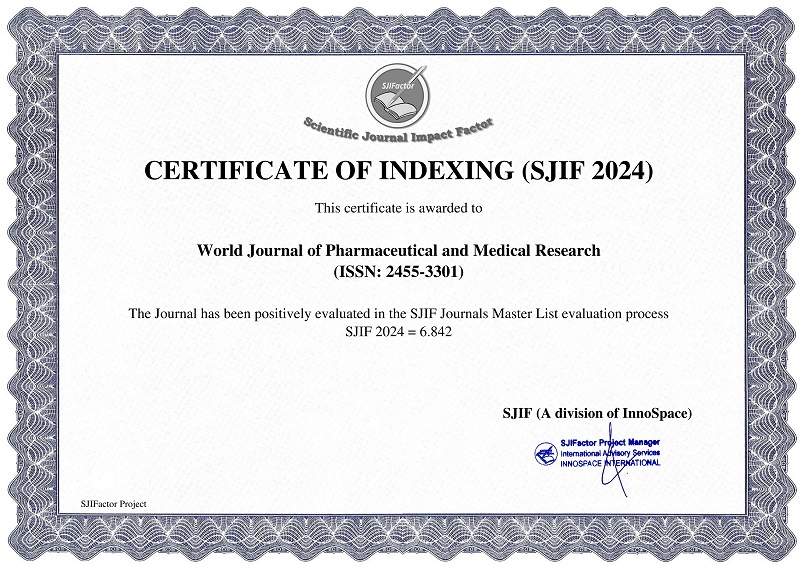
World Journal of Pharmaceutical and Medical Research (WJPMR) has indexed with various reputed international bodies like : Google Scholar , Index Copernicus , SOCOLAR, China , Indian Science Publications , Cosmos Impact Factor , Research Bible, Fuchu, Tokyo. JAPAN , Scientific Indexing Services (SIS) , UDLedge Science Citation Index , International Impact Factor Services , International Society for Research Activity (ISRA) Journal Impact Factor (JIF) , International Innovative Journal Impact Factor (IIJIF) , Scientific Journal Impact Factor (SJIF) , Global Impact Factor (In Process) , Digital Online Identifier-Database System (DOI-DS) , Science Library Index, Dubai, United Arab Emirates , Eurasian Scientific Journal Index (ESJI) , International Scientific Indexing, (ISI) UAE , IFSIJ Measure of Journal Quality , Web of Science Group (Under Process) , Directory of Research Journals Indexing , Scholar Article Journal Index (SAJI) , International Scientific Indexing ( ISI ) , Scope Database , Academia , Doi-Digital Online Identifier , ISSN National Centre , Zenodo Indexing , International CODEN Service, USA , 

Abstract

A REVIEW ON INFLUENTIAL FACTORS AFFECTING THE THERAPEUTIC EFFECT OF AYURVEDIC DRUGS: DESHA, KALA, MATRA AND ANUPANA

*Vd. Harshali B. Bhakare

ABSTRACT

Ayurveda recognizes that the therapeutic action of a medicinal substance is influenced not only by its inherent properties but also by contextual factors. Among these, Desha (place), Kala (time), Matra (dose) and Anupana (vehicle/co-administered substance) have particular importance in Dravyaguna and clinical practice. Desha may influence growth, quality and phytochemical profile; Kala influences collection, seasonal variation, storage and timing of administration; Matra determines the quantity required for an appropriate therapeutic response; and Anupana may influence administration, palatability, tolerability, absorption and therapeutic response. These concepts demonstrate the individualized nature of Ayurvedic pharmacotherapy. The same drug may not produce identical effects when obtained from different ecological regions, collected at different stages, administered in an inappropriate quantity or given with an unsuitable Anupana. Contemporary pharmacognosy, pharmacology and chronopharmacology provide useful parallels. This review examines Desha, Kala, Matra and Anupana, their influence on drug quality and therapeutic action, and their clinical and research relevance

[Full Text Article]    [Download Certificate]

Powered By WJPMR | All Right Reserved

Count age days