

World Journal of Pharmaceutical
and Medical Research

( An ISO 9001:2015 Certified International Journal )

An International Peer Reviewed Journal for Pharmaceutical and Medical Research and Technology
An Official Publication of Society for Advance Healthcare Research (Reg. No. : 01/01/01/31674/16)
ISSN (O) : 2455-3301
ISSN (P) : 3051-2557
IMPACT FACTOR: 7.533

ICV : 78.6

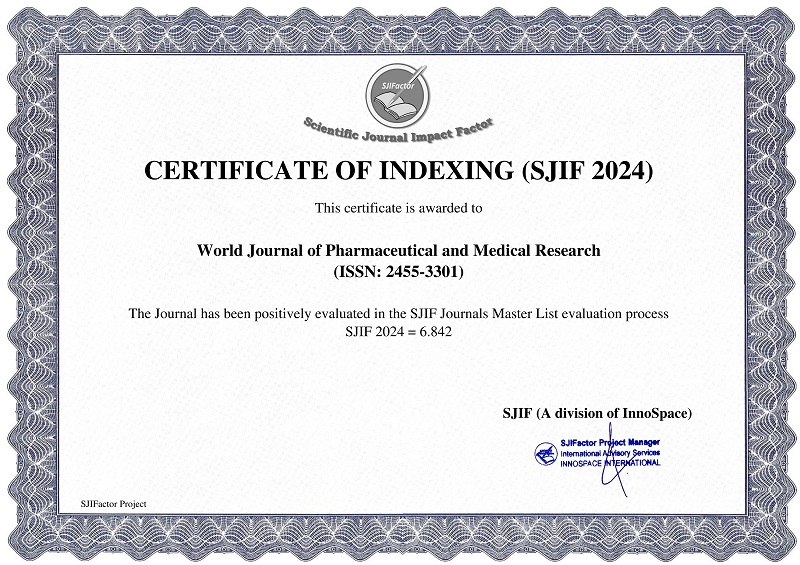
World Journal of Pharmaceutical and Medical Research (WJPMR) has indexed with various reputed international bodies like : Google Scholar , Index Copernicus , SOCOLAR, China , Indian Science Publications , Cosmos Impact Factor , Research Bible, Fuchu, Tokyo. JAPAN , Scientific Indexing Services (SIS) , UDLedge Science Citation Index , International Impact Factor Services , International Society for Research Activity (ISRA) Journal Impact Factor (JIF) , International Innovative Journal Impact Factor (IIJIF) , Scientific Journal Impact Factor (SJIF) , Global Impact Factor (In Process) , Digital Online Identifier-Database System (DOI-DS) , Science Library Index, Dubai, United Arab Emirates , Eurasian Scientific Journal Index (ESJI) , International Scientific Indexing, (ISI) UAE , IFSIJ Measure of Journal Quality , Web of Science Group (Under Process) , Directory of Research Journals Indexing , Scholar Article Journal Index (SAJI) , International Scientific Indexing ( ISI ) , Scope Database , Academia , Doi-Digital Online Identifier , ISSN National Centre , Zenodo Indexing , International CODEN Service, USA , 

Abstract

A REVIEW ON ROLE OF ARTIFICIAL INTELLIGENCE IN CLINICAL PHARMACY

Mr Balasubramaniyan P., Dr. M. K. Sundar Sri, Dr. M. Kalaiarasan*

ABSTRACT

Artificial intelligence (AI) revolutionizes healthcare in terms of decision making, patient safety, and the optimization of health services. The role of AI technologies in clinical pharmacy involves medication management, therapeutic monitoring, pharmacovigilance, prescription verification, and personalized medicine. Machine learning, deep learning, natural language processing, computer vision, and generative AI allow analyzing massive amounts of health-related data for evidence-based pharmaceutical care. AI-empowered tools help identify medication mistakes, adverse reactions, drug interactions, and adherence problems. AI contributes to patient counseling, antimicrobial stewardship, risk prediction, and clinical documentation for clinical pharmacists. Even though AI offers numerous benefits, such challenges as the lack of privacy and ethics in data use, the need for algorithm transparency, and high implementation cost should be taken into account. Further development and collaboration are likely to make clinical pharmacy even more effective.

[Full Text Article]    [Download Certificate]

Powered By WJPMR | All Right Reserved

WJPMR