

World Journal of Pharmaceutical
and Medical Research

( An ISO 9001:2015 Certified International Journal )

An International Peer Reviewed Journal for Pharmaceutical and Medical Research and Technology
An Official Publication of Society for Advance Healthcare Research (Reg. No. : 01/01/01/31674/16)
ISSN (O) : 2455-3301
ISSN (P) : 3051-2557
IMPACT FACTOR: 7.533

ICV : 78.6

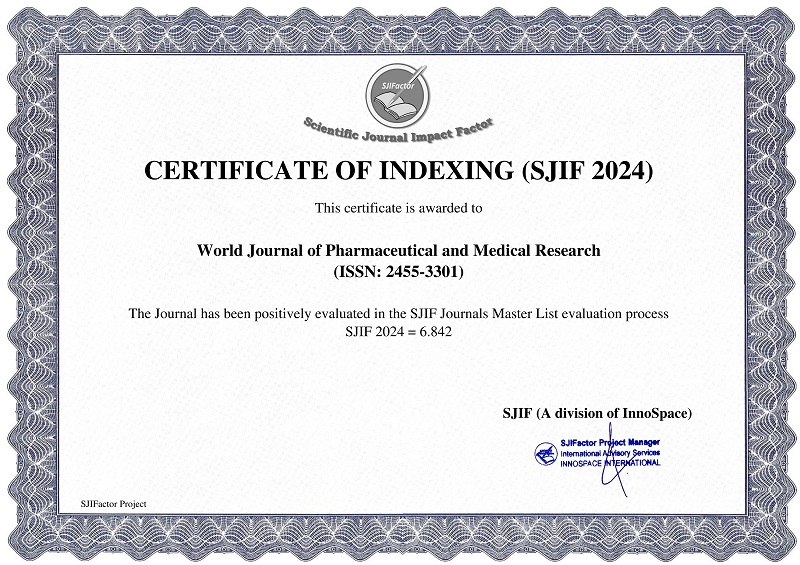
World Journal of Pharmaceutical and Medical Research (WJPMR) has indexed with various reputed international bodies like : Google Scholar , Index Copernicus , SOCOLAR, China , Indian Science Publications , Cosmos Impact Factor , Research Bible, Fuchu, Tokyo. JAPAN , Scientific Indexing Services (SIS) , UDLedge Science Citation Index , International Impact Factor Services , International Society for Research Activity (ISRA) Journal Impact Factor (JIF) , International Innovative Journal Impact Factor (IIJIF) , Scientific Journal Impact Factor (SJIF) , Global Impact Factor (In Process) , Digital Online Identifier-Database System (DOI-DS) , Science Library Index, Dubai, United Arab Emirates , Eurasian Scientific Journal Index (ESJI) , International Scientific Indexing, (ISI) UAE , IFSIJ Measure of Journal Quality , Web of Science Group (Under Process) , Directory of Research Journals Indexing , Scholar Article Journal Index (SAJI) , International Scientific Indexing ( ISI ) , Scope Database , Academia , Doi-Digital Online Identifier , ISSN National Centre , Zenodo Indexing , International CODEN Service, USA , 

Abstract

AYURVEDIC MANAGEMENT OF PILONIDAL SINUS (SHALYAJA NADI VRANA): A REVIEW STUDY

Dr. Omkar Gharat*, Dr. Sumedh Wasnik, Dr. Mahesh Joshi, Dr. Anuradha Tirmane

ABSTRACT

Pilonidal sinus disease is a chronic acquired disorder of the sacrococcygeal region that causes considerable morbidity and increases healthcare expenditure. Numerous surgical and conservative treatment methods have been proposed, yet no single modality has achieved universal acceptance. The condition commonly develops in the natal cleft due to the accumulation of loose hair within hair follicles, leading to chronic sinus formation with occasional acute flare-ups. Patients usually present with classical signs of inflammation such as pain, swelling, redness, increased local temperature, and purulent or serous discharge from the sinus tract. Risk factors including prolonged sitting, obesity, a deep natal cleft, repeated local irritation by hair, and positive family history contribute to the development of the disease. In Ayurvedic literature, pilonidal sinus can be correlated with Nadi Vrana. Acharya Sushruta has described eight varieties of Nadi Vrana, among which pilonidal sinus may be classified under Shalyaja Nadi Vrana.

[Full Text Article]    [Download Certificate]

Powered By WJPMR | All Right Reserved

WJPMR