

World Journal of Pharmaceutical
and Medical Research

( An ISO 9001:2015 Certified International Journal )

An International Peer Reviewed Journal for Pharmaceutical and Medical Research and Technology
An Official Publication of Society for Advance Healthcare Research (Reg. No. : 01/01/01/31674/16)
ISSN (O) : 2455-3301
ISSN (P) : 3051-2557
IMPACT FACTOR: 7.533

ICV : 78.6

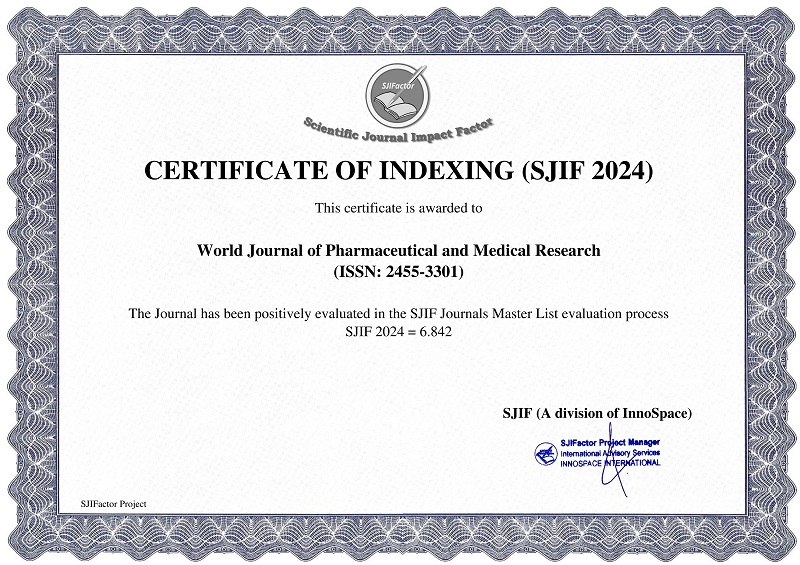
World Journal of Pharmaceutical and Medical Research (WJPMR) has indexed with various reputed international bodies like : Google Scholar , Index Copernicus , SOCOLAR, China , Indian Science Publications , Cosmos Impact Factor , Research Bible, Fuchu, Tokyo. JAPAN , Scientific Indexing Services (SIS) , UDLedge Science Citation Index , International Impact Factor Services , International Society for Research Activity (ISRA) Journal Impact Factor (JIF) , International Innovative Journal Impact Factor (IIJIF) , Scientific Journal Impact Factor (SJIF) , Global Impact Factor (In Process) , Digital Online Identifier-Database System (DOI-DS) , Science Library Index, Dubai, United Arab Emirates , Eurasian Scientific Journal Index (ESJI) , International Scientific Indexing, (ISI) UAE , IFSIJ Measure of Journal Quality , Web of Science Group (Under Process) , Directory of Research Journals Indexing , Scholar Article Journal Index (SAJI) , International Scientific Indexing ( ISI ) , Scope Database , Academia , Doi-Digital Online Identifier , ISSN National Centre , Zenodo Indexing , International CODEN Service, USA , 

Abstract

AN INTEGRATIVE REVIEW OF ANATOMICAL CHANGES IN GULPHA SANDHI IN AMAVATA ACORRDING AYURVEDA AND MODERN SCIENCE

Kashiwar Shweta Pandhari*, Choudhari Vinod Mahadeorao, Yadav Janvi Bhimshing

ABSTRACT

This review focuses on the structural and functional alterations in Gulpha Sandhi Sharir (ankle joint) with particular reference to Amavata. In Ayurvedic science, the Gulpha Sandhi represents the ankle joint, a vital component responsible for locomotion and stability. Amavata is a long-standing inflammatory disorder that shows strong similarity to rheumatoid arthritis and mainly affects joints, producing symptoms such as pain, swelling, stiffness, and restricted movement. The present study evaluates important anatomical elements of the Gulpha Sandhi, including bones, ligaments, tendons, and synovial membranes, and elaborates on how these are affected during Amavata. By correlating descriptions from classical Ayurvedic literature with modern medical understanding, the study explains the pathogenesis of Amavata, particularly emphasizing the accumulation of Ama (toxic metabolites) and its interaction with Vata Dosha. Key pathological features such as joint tissue degeneration, synovial fluid abnormalities, and inflammatory processes are discussed. The study aims to integrate Ayurvedic concepts with modern anatomical perspectives to provide deeper insight into the effective management of this condition.

[Full Text Article]    [Download Certificate]

Powered By WJPMR | All Right Reserved

WJPMR