

World Journal of Pharmaceutical
and Medical Research

( An ISO 9001:2015 Certified International Journal )

An International Peer Reviewed Journal for Pharmaceutical and Medical Research and Technology
An Official Publication of Society for Advance Healthcare Research (Reg. No. : 01/01/01/31674/16)
ISSN (O) : 2455-3301
ISSN (P) : 3051-2557
IMPACT FACTOR: 7.533

ICV : 78.6

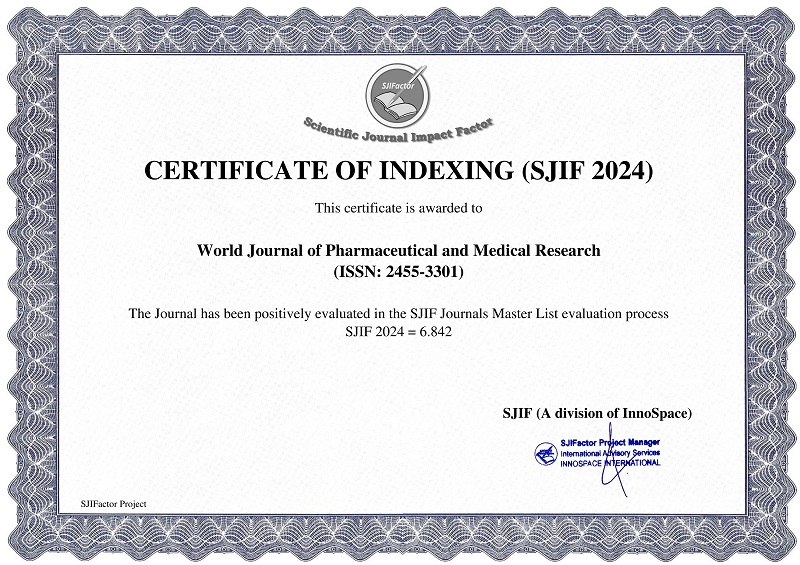
World Journal of Pharmaceutical and Medical Research (WJPMR) has indexed with various reputed international bodies like : Google Scholar , Index Copernicus , SOCOLAR, China , Indian Science Publications , Cosmos Impact Factor , Research Bible, Fuchu, Tokyo. JAPAN , Scientific Indexing Services (SIS) , UDLedge Science Citation Index , International Impact Factor Services , International Society for Research Activity (ISRA) Journal Impact Factor (JIF) , International Innovative Journal Impact Factor (IIJIF) , Scientific Journal Impact Factor (SJIF) , Global Impact Factor (In Process) , Digital Online Identifier-Database System (DOI-DS) , Science Library Index, Dubai, United Arab Emirates , Eurasian Scientific Journal Index (ESJI) , International Scientific Indexing, (ISI) UAE , IFSIJ Measure of Journal Quality , Web of Science Group (Under Process) , Directory of Research Journals Indexing , Scholar Article Journal Index (SAJI) , International Scientific Indexing ( ISI ) , Scope Database , Academia , Doi-Digital Online Identifier , ISSN National Centre , Zenodo Indexing , International CODEN Service, USA , 

Abstract

A COMPARATIVE LITERATURE REVIEW: ANATOMY OF THE FOETAL SKULL

Dr. Rajeev Agnihotri*, Dr. O. P. Dwivedi, Dr. Vikas Khare, Dr. Shrikant Patel, Dr. Sucheta Ray

ABSTRACT

Introduction: The fetal skull is the most difficult part of the baby to pass through the mother’s pelvic canal, due to the hard bony nature of the skull. It protects the brain Understanding the anatomy of the fetal skull and its diameter will help you recognise how a labour is progressing, and whether the baby’s head is ‘presenting’ correctly as it comes down the birth canal. According to Acharya Sushrut six bones are present in the head. These bones separate in intrauterine life & the movement of these bones is helpful at the time of delivery. Afterward these bones attach with each other keeping mark on it & these are called as sevani. Conclusion: The skull is formed by several bones joined tightly together by joints called sutures. In the fetus and newborn, spaces called fontanels exist between some of the skull bones on the top of the baby’s head. As per Ayurveda there are six bones present in the head. These bones separate in intrauterine life & the movement of these bones is helpful at the time of delivery.

[Full Text Article]    [Download Certificate]

Powered By WJPMR | All Right Reserved

WJPMR