
World Journal of Pharmaceutical
and Medical Research

( An ISO 9001:2015 Certified International Journal )

An International Peer Reviewed Journal for Pharmaceutical and Medical Research and Technology
An Official Publication of Society for Advance Healthcare Research (Reg. No. : 01/01/01/31674/16)
ISSN (O) : 2455-3301
ISSN (P) : 3051-2557
IMPACT FACTOR: 7.533

ICV : 78.6

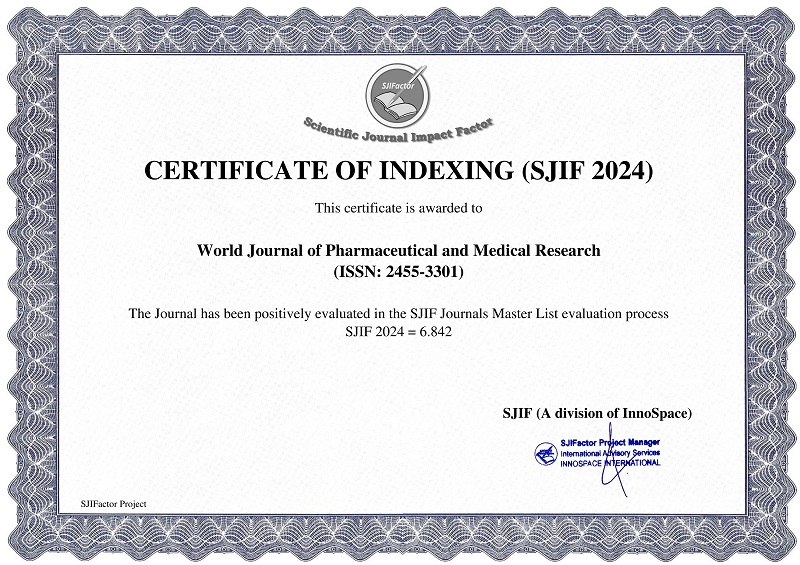
World Journal of Pharmaceutical and Medical Research (WJPMR) has indexed with various reputed international bodies like : Google Scholar , Index Copernicus , SOCOLAR, China , Indian Science Publications , Cosmos Impact Factor , Research Bible, Fuchu, Tokyo. JAPAN , Scientific Indexing Services (SIS) , UDLedge Science Citation Index , International Impact Factor Services , International Society for Research Activity (ISRA) Journal Impact Factor (JIF) , International Innovative Journal Impact Factor (IIJIF) , Scientific Journal Impact Factor (SJIF) , Global Impact Factor (In Process) , Digital Online Identifier-Database System (DOI-DS) , Science Library Index, Dubai, United Arab Emirates , Eurasian Scientific Journal Index (ESJI) , International Scientific Indexing, (ISI) UAE , IFSIJ Measure of Journal Quality , Web of Science Group (Under Process) , Directory of Research Journals Indexing , Scholar Article Journal Index (SAJI) , International Scientific Indexing ( ISI ) , Scope Database , Academia , Doi-Digital Online Identifier , ISSN National Centre , Zenodo Indexing , International CODEN Service, USA , 

Abstract

A CRITICAL APPRAISAL OF ATISARA NIDANA IN ASHTANGA HRIDAYAM

C. Krishna Devaki*, Gujjarwar Vidula, Kushwaha Nidhi, Sharma Sahil

ABSTRACT

Atisara is the abnormal passage of liquid stool, wherein Agnimandya (impaired digestive fire) leading to Ama (unassimilated food) is the root cause. This review examines the Nidanas described in Ashtanga Hridaya from a current medical perspective, highlighting their similarity in concepts with the contemporary disease mechanisms of diarrhoea. Classical Ayurvedic literature elaborates causes such as excessive fluid intake, unaccustomed dietary intake, irregular meal patterns, suppressing urges, regular use of dry meat, sesame, flour preparations, sprouts, and alcohol that closely align with the modern mechanisms, including high osmotic load, dysbiosis, modifications in gut microbiota composition, impairment in digestive function, alteration in gut motility and intestinal permeability and circadian rhythm disruption. Understanding these connections helps physicians in the early detection of these precipitating factors, thereby planning a multidisciplinary management strategy and implementing better choices in patient care.

[Full Text Article]    [Download Certificate]

Powered By WJPMR | All Right Reserved

WJPMR