

World Journal of Pharmaceutical
and Medical Research

( An ISO 9001:2015 Certified International Journal )

An International Peer Reviewed Journal for Pharmaceutical and Medical Research and Technology
An Official Publication of Society for Advance Healthcare Research (Reg. No. : 01/01/01/31674/16)
ISSN (O) : 2455-3301
ISSN (P) : 3051-2557
IMPACT FACTOR: 7.533

ICV : 78.6

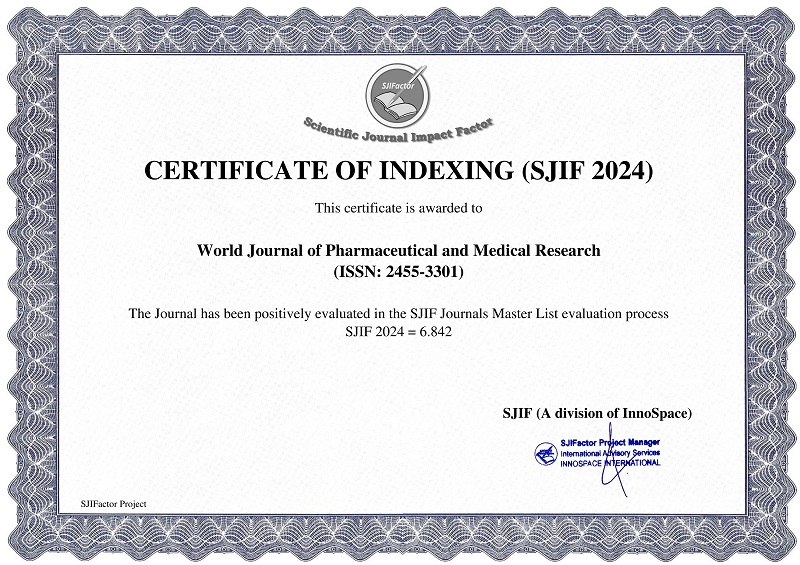
World Journal of Pharmaceutical and Medical Research (WJPMR) has indexed with various reputed international bodies like : Google Scholar , Index Copernicus , SOCOLAR, China , Indian Science Publications , Cosmos Impact Factor , Research Bible, Fuchu, Tokyo. JAPAN , Scientific Indexing Services (SIS) , UDLedge Science Citation Index , International Impact Factor Services , International Society for Research Activity (ISRA) Journal Impact Factor (JIF) , International Innovative Journal Impact Factor (IIJIF) , Scientific Journal Impact Factor (SJIF) , Global Impact Factor (In Process) , Digital Online Identifier-Database System (DOI-DS) , Science Library Index, Dubai, United Arab Emirates , Eurasian Scientific Journal Index (ESJI) , International Scientific Indexing, (ISI) UAE , IFSIJ Measure of Journal Quality , Web of Science Group (Under Process) , Directory of Research Journals Indexing , Scholar Article Journal Index (SAJI) , International Scientific Indexing ( ISI ) , Scope Database , Academia , Doi-Digital Online Identifier , ISSN National Centre , Zenodo Indexing , International CODEN Service, USA , 

Abstract

MYASTHENIA GRAVIS: A COMPREHENSIVE REVIEW OF AN AUTOIMMUNE NEUROMUSCULAR DISORDER

Dr. K. Siva Rama Gandhi*, Dr. N. Suvarna Jyothi, Yadla Jerusha Gold, Gogannamatam Lalitha Sagar, Vara Sravanthi, Burra Ramyasri

ABSTRACT

Myasthenia gravis (MG) is a chronic autoimmune disorder of the neuromuscular junction characterized by fluctuating skeletal muscle weakness and abnormal fatigability. The condition is primarily caused by autoantibodies directed against postsynaptic acetylcholine receptors, and less commonly against muscle-specific kinase or related proteins, leading to impaired neuromuscular transmission. Clinically, MG presents with variable involvement of ocular, bulbar, limb, and respiratory muscles, with symptoms typically worsening on exertion and improving with rest. Diagnosis is established through clinical evaluation supported by serological testing, electrophysiological studies, and imaging of the thymus. Management includes acetylcholinesterase inhibitors, immunosuppressive therapy, thymectomy, and immunomodulatory treatments such as plasmapheresis and intravenous immunoglobulin. Recent advances in targeted immunotherapies have further improved disease control and patient outcomes. This review provides a comprehensive overview of the etiology, pathophysiology, clinical features, diagnostic approaches, and current management strategies for myasthenia gravis, emphasizing the importance of early diagnosis and individualized treatment to enhance quality of life.

[Full Text Article]    [Download Certificate]

Powered By WJPMR | All Right Reserved

WJPMR