World Journal of Pharmaceutical
and Medical Research

( An ISO 9001:2015 Certified International Journal )

An International Peer Reviewed Journal for Pharmaceutical and Medical Research and Technology
An Official Publication of Society for Advance Healthcare Research (Reg. No. : 01/01/01/31674/16)
ISSN (O) : 2455-3301
ISSN (P) : 3051-2557
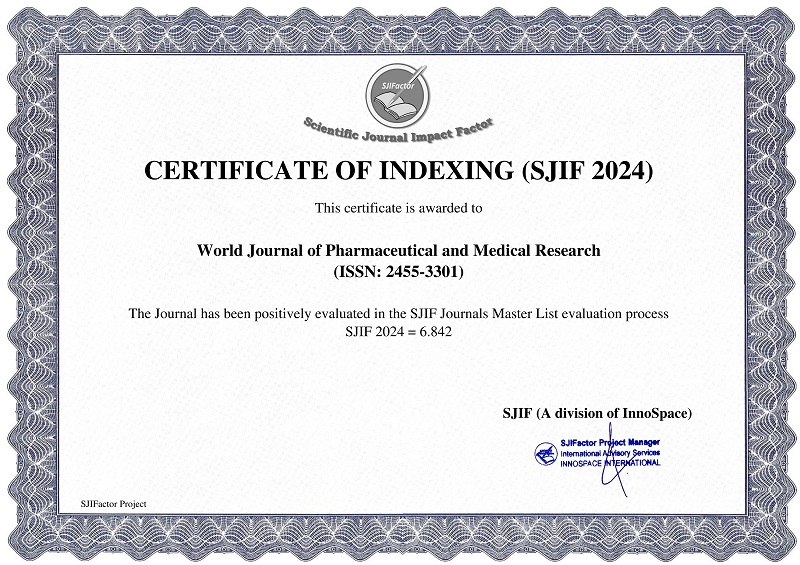
IMPACT FACTOR: 6.842

ICV : 78.6

World Journal of Pharmaceutical and Medical Research (WJPMR) has indexed with various reputed international bodies like : Google Scholar , Index Copernicus , SOCOLAR, China , Indian Science Publications , Cosmos Impact Factor , Research Bible, Fuchu, Tokyo. JAPAN , Scientific Indexing Services (SIS) , UDLedge Science Citation Index , International Impact Factor Services , International Society for Research Activity (ISRA) Journal Impact Factor (JIF) , International Innovative Journal Impact Factor (IIJIF) , Scientific Journal Impact Factor (SJIF) , Global Impact Factor (In Process) , Digital Online Identifier-Database System (DOI-DS) , Science Library Index, Dubai, United Arab Emirates , Eurasian Scientific Journal Index (ESJI) , International Scientific Indexing, (ISI) UAE , IFSIJ Measure of Journal Quality , Web of Science Group (Under Process) , Directory of Research Journals Indexing , Scholar Article Journal Index (SAJI) , International Scientific Indexing ( ISI ) , Scope Database , Academia , Doi-Digital Online Identifier , ISSN National Centre , Zenodo Indexing , International CODEN Service, USA , 

Abstract

AYURVEDIC INSIGHT OF BHASMA IN AMAVATA

Sharma Shivani, Rupali*

ABSTRACT

Amavata, a chronic inflammatory disorder described in Ayurveda, closely parallels Rheumatoid Arthritis in its clinical presentation of joint pain, swelling, stiffness, and systemic features arising from the interaction of aggravated Vata Dosha and accumulated Ama. Traditional Ayurvedic management emphasizes Deepana, Pachana, Vata-shamana and Shothahara therapies, in which Bhasma preparations play a significant role. Bhasmas—calcined metallic and mineral formulations—possess unique physicochemical properties including Sukshma (nano-sized particles), Laghu, Deepana and Rasayana qualities that enhance their bioavailability, tissue penetration, and therapeutic efficacy. Contemporary analytical studies (TEM, SEM, XRD) confirm that Abhraka, Swarna, Lauha, Tamra, Naga and Vanga Bhasmas contain nanoparticles ranging from 10–100 nm, correlating with modern nanomedicine concepts. These nanoparticles exhibit anti-inflammatory, antioxidant, immunomodulatory and mitochondrial-enhancing actions, supporting their role in Amavata by promoting Ama-pachana, Agni-deepana, Vata-shamana, Srotoshodhana and tissue rejuvenation. This conceptual review integrates Ayurvedic principles with modern scientific findings to elucidate the pharmacodynamics, safety, and therapeutic rationale of Bhasma in Amavata, highlighting their potential as natural nanomedicines for effective management of inflammatory joint disorders.

[Full Text Article]    [Download Certificate]

Powered By WJPMR | All Right Reserved

WJPMR