
World Journal of Pharmaceutical
and Medical Research

( An ISO 9001:2015 Certified International Journal )

An International Peer Reviewed Journal for Pharmaceutical and Medical Research and Technology
An Official Publication of Society for Advance Healthcare Research (Reg. No. : 01/01/01/31674/16)
ISSN (O) : 2455-3301
ISSN (P) : 3051-2557
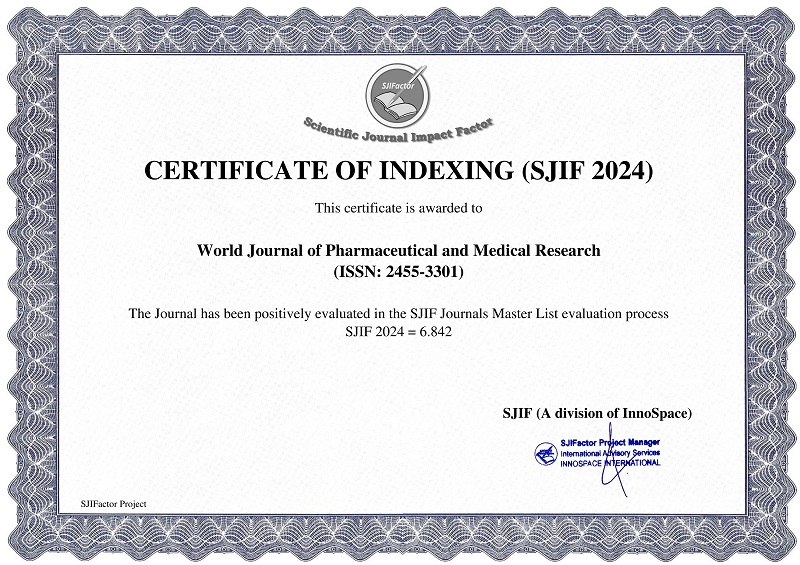
IMPACT FACTOR: 6.842

ICV : 78.6

World Journal of Pharmaceutical and Medical Research (WJPMR) has indexed with various reputed international bodies like : Google Scholar , Index Copernicus , SOCOLAR, China , Indian Science Publications , Cosmos Impact Factor , Research Bible, Fuchu, Tokyo. JAPAN , Scientific Indexing Services (SIS) , UDLedge Science Citation Index , International Impact Factor Services , International Society for Research Activity (ISRA) Journal Impact Factor (JIF) , International Innovative Journal Impact Factor (IIJIF) , Scientific Journal Impact Factor (SJIF) , Global Impact Factor (In Process) , Digital Online Identifier-Database System (DOI-DS) , Science Library Index, Dubai, United Arab Emirates , Eurasian Scientific Journal Index (ESJI) , International Scientific Indexing, (ISI) UAE , IFSIJ Measure of Journal Quality , Web of Science Group (Under Process) , Directory of Research Journals Indexing , Scholar Article Journal Index (SAJI) , International Scientific Indexing ( ISI ) , Scope Database , Academia , Doi-Digital Online Identifier , ISSN National Centre , Zenodo Indexing , International CODEN Service, USA , 

Abstract

UNDERSTANDING RINGWORM: A REVIEW ON CLINICAL, THERAPEUTIC AND RISK FACTORS OF TINEA INFECTIONS

S. Poojitha*, K. Manimala, R. Anusha, Dr. G. Sandhya, Dr. CH. Sampath Kumar, Dr. K. Purnachander

ABSTRACT

Dermatophytosis also known as Ringworm continues to be one of the most widespread superficial fungal infections globally, involving skin, hair and nails and being caused primarily by dermatophytes of the genera Trichophyton, Microsporum and Epidermophyton. While once held to be readily curable, recent years have seen significant shifts in its epidemiology, clinical presentation and therapeutic responsiveness. This review integrates existing evidence on four main areas – Clinical presentations, Treatment patterns- reporting topical and systemic antifungal treatment strategies , Risk factors and Emerging antifungal resistance pointing to increasing evidence of reduced susceptibility and documented molecular mechanisms facilitating resistance. The review highlights the imperative need for increased diagnostic vigilance, current treatment guidelines, prevention-focused education on hygiene and monitoring of resistant strains of dermatophytes. By synthesizing the most current understanding, this article is intended to assist clinicians and public-health partners in combating the changing problem of dermatophytosis in the 21st century.

[Full Text Article]    [Download Certificate]

Powered By WJPMR | All Right Reserved

WJPMR