World Journal of Pharmaceutical
and Medical Research

( An ISO 9001:2015 Certified International Journal )

An International Peer Reviewed Journal for Pharmaceutical and Medical Research and Technology
An Official Publication of Society for Advance Healthcare Research (Reg. No. : 01/01/01/31674/16)
ISSN (O) : 2455-3301
ISSN (P) : 3051-2557
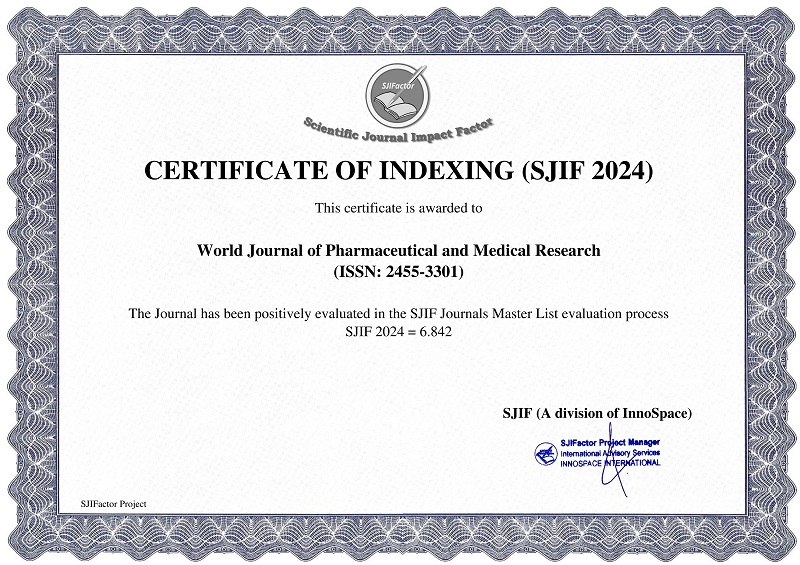
IMPACT FACTOR: 6.842

ICV : 78.6

World Journal of Pharmaceutical and Medical Research (WJPMR) has indexed with various reputed international bodies like : Google Scholar , Index Copernicus , SOCOLAR, China , Indian Science Publications , Cosmos Impact Factor , Research Bible, Fuchu, Tokyo. JAPAN , Scientific Indexing Services (SIS) , UDLedge Science Citation Index , International Impact Factor Services , International Society for Research Activity (ISRA) Journal Impact Factor (JIF) , International Innovative Journal Impact Factor (IIJIF) , Scientific Journal Impact Factor (SJIF) , Global Impact Factor (In Process) , Digital Online Identifier-Database System (DOI-DS) , Science Library Index, Dubai, United Arab Emirates , Eurasian Scientific Journal Index (ESJI) , International Scientific Indexing, (ISI) UAE , IFSIJ Measure of Journal Quality , Web of Science Group (Under Process) , Directory of Research Journals Indexing , Scholar Article Journal Index (SAJI) , International Scientific Indexing ( ISI ) , Scope Database , Academia , Doi-Digital Online Identifier , ISSN National Centre , Zenodo Indexing , International CODEN Service, USA , 

Abstract

MENORRHAGIA AND ITS AYURVEDIC CORRELATION - ASRIGDARA: A REVIEW ARTICLE

Sandeep Jadhav*, Vidya Sarode

ABSTRACT

Menorrhagia, clinically defined as excessive or prolonged uterine bleeding, is a substantial cause of morbidity in women. In Ayurveda, the analogous condition is Asrigdara (Raktapradara), characterized by vitiation of Pitta and Rakta, disturbance of Apana Vayu, and deranged uterine channels. This review critically examines classical Ayurvedic theory (etiology, pathogenesis, classification, clinical features) and collates modern clinical and experimental evidence on Ayurvedic management (herbal therapies, Panchakarma, dietary/lifestyle measures). Several trials and case reports demonstrate symptomatic improvements, especially when combining Shodhana and Shamana approaches, but limitations (small size, lack of controls, nonstandard outcomes) persist. We discuss therapeutic principles (Raktastambhana, Raktavardhana, dosha pacification, Basti therapies), analyze evidence gaps and safety concerns, and propose future directions including rigorous randomized trials, standardized formulations, objective outcome metrics, and integration with modern diagnostics.

[Full Text Article]    [Download Certificate]

Powered By WJPMR | All Right Reserved

WJPMR