World Journal of Pharmaceutical
and Medical Research

( An ISO 9001:2015 Certified International Journal )

An International Peer Reviewed Journal for Pharmaceutical and Medical Research and Technology
An Official Publication of Society for Advance Healthcare Research (Reg. No. : 01/01/01/31674/16)
ISSN (O) : 2455-3301
ISSN (P) : 3051-2557
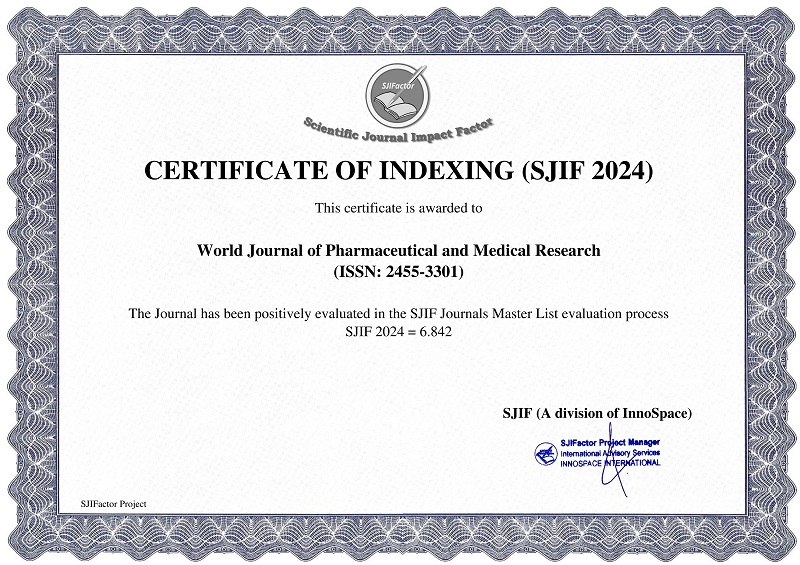
IMPACT FACTOR: 6.842

ICV : 78.6

World Journal of Pharmaceutical and Medical Research (WJPMR) has indexed with various reputed international bodies like : Google Scholar , Index Copernicus , SOCOLAR, China , Indian Science Publications , Cosmos Impact Factor , Research Bible, Fuchu, Tokyo. JAPAN , Scientific Indexing Services (SIS) , UDLedge Science Citation Index , International Impact Factor Services , International Society for Research Activity (ISRA) Journal Impact Factor (JIF) , International Innovative Journal Impact Factor (IIJIF) , Scientific Journal Impact Factor (SJIF) , Global Impact Factor (In Process) , Digital Online Identifier-Database System (DOI-DS) , Science Library Index, Dubai, United Arab Emirates , Eurasian Scientific Journal Index (ESJI) , International Scientific Indexing, (ISI) UAE , IFSIJ Measure of Journal Quality , Web of Science Group (Under Process) , Directory of Research Journals Indexing , Scholar Article Journal Index (SAJI) , International Scientific Indexing ( ISI ) , Scope Database , Academia , Doi-Digital Online Identifier , ISSN National Centre , Zenodo Indexing , International CODEN Service, USA , 

Abstract

OMPLICATION OF VAMANA AND THEIR MANAGEMENT WITH AYURVEDA AND MODERN APPROACHES: A REVIEW

Dr. Chandravijay Radhakishan Bhoyare*, Dr. Vijay Ganeshrao Kawale, Dr. Sudhir Kisanrao Bhujbale

ABSTRACT

Vamana, is one of the Panchakarma therapies in Ayurveda, is intended to remove excessive Kapha Dosha from the body. Excessive Kapha can lead to conditions such as cough and cold, while mild excess can be managed through oral medication. Severe aggravation or dislodgment of Kapha at its site requires therapeutic emesis. Vamana helps to expel Kapha primarily through the oral root. The process involves moving Kapha from the peripheral tissues and organs into the stomach, where it is subsequently vomited out. Complications may also develop from conducting Vamana therapy improperly, either in Atiyoga and/or Ayoga. After Vamana, the patient should refrain from any activities that might disturb the recovery phase, to include loud talking, eating large amounts, long sitting, long walks, moods of anger and grief or extremes of external environmental factors such as sun, dew, or pungent wind. After Vamana, Agni is weak, therefore it is essential to build normalized digestibility back to its original state. This article described complication of Vamana and their management through Ayurveda and modern approaches.

[Full Text Article]    [Download Certificate]

Powered By WJPMR | All Right Reserved

WJPMR