World Journal of Pharmaceutical
and Medical Research

( An ISO 9001:2015 Certified International Journal )

An International Peer Reviewed Journal for Pharmaceutical and Medical Research and Technology
An Official Publication of Society for Advance Healthcare Research (Reg. No. : 01/01/01/31674/16)
ISSN (O) : 2455-3301
ISSN (P) : 3051-2557
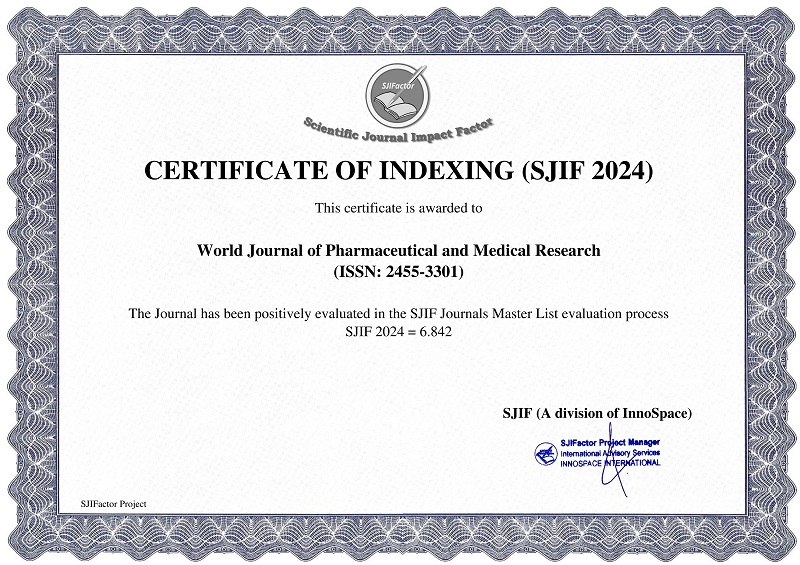
IMPACT FACTOR: 6.842

ICV : 78.6

World Journal of Pharmaceutical and Medical Research (WJPMR) has indexed with various reputed international bodies like : Google Scholar , Index Copernicus , SOCOLAR, China , Indian Science Publications , Cosmos Impact Factor , Research Bible, Fuchu, Tokyo. JAPAN , Scientific Indexing Services (SIS) , UDLedge Science Citation Index , International Impact Factor Services , International Society for Research Activity (ISRA) Journal Impact Factor (JIF) , International Innovative Journal Impact Factor (IIJIF) , Scientific Journal Impact Factor (SJIF) , Global Impact Factor (In Process) , Digital Online Identifier-Database System (DOI-DS) , Science Library Index, Dubai, United Arab Emirates , Eurasian Scientific Journal Index (ESJI) , International Scientific Indexing, (ISI) UAE , IFSIJ Measure of Journal Quality , Web of Science Group (Under Process) , Directory of Research Journals Indexing , Scholar Article Journal Index (SAJI) , International Scientific Indexing ( ISI ) , Scope Database , Academia , Doi-Digital Online Identifier , ISSN National Centre , Zenodo Indexing , International CODEN Service, USA , 

Abstract

TEXTUAL EVOLUTION OF DUGDHIKA IN AYURVEDIC LITERATURE: A SYSTEMATIC REVIEW FROM SAMHITAS TO NIGHANTUS

Ekta Singh*, Ramakant Marde, S. M. Tripathi

ABSTRACT

The plant Dugdhika (Euphorbia hirta Linn.), also known by synonyms such as Kshirini, Rajashavak, and Dudhi, has been referenced throughout Ayurvedic literature for its therapeutic properties. This study aims to review systematically the presence, synonyms, and medicinal applications of Dugdhika in Vedic texts, Samhitas, and Nighantus. Data were compiled from primary Ayurvedic sources including Charaka, Sushruta, Ashtanga Hridaya, Bhavaprakasha, Kashyapa Samhita, and subsequent Nighantu literature from the 7th century A.D. to modern works. Results reveal that while Dugdhika is absent in the Vedas, its first detailed mention occurs in the Charaka Samhita, where it is recommended in various formulations for disorders such as Rajayakshma, Arsha, Atisara, and Palitya. Later Samhitas including Sushruta, Ashtanga Hridaya, and Ashtanga Sangraha also provide references, though with varying therapeutic focus. In the Nighantus, Dugdhika is absent in the earliest lexicons but gains prominence from the 9th century A.D. onward, appearing with numerous synonyms and categorized across diverse Vargas. The review highlights its evolving recognition in Ayurveda, reflecting its enduring therapeutic relevance.

[Full Text Article]    [Download Certificate]

Powered By WJPMR | All Right Reserved

WJPMR